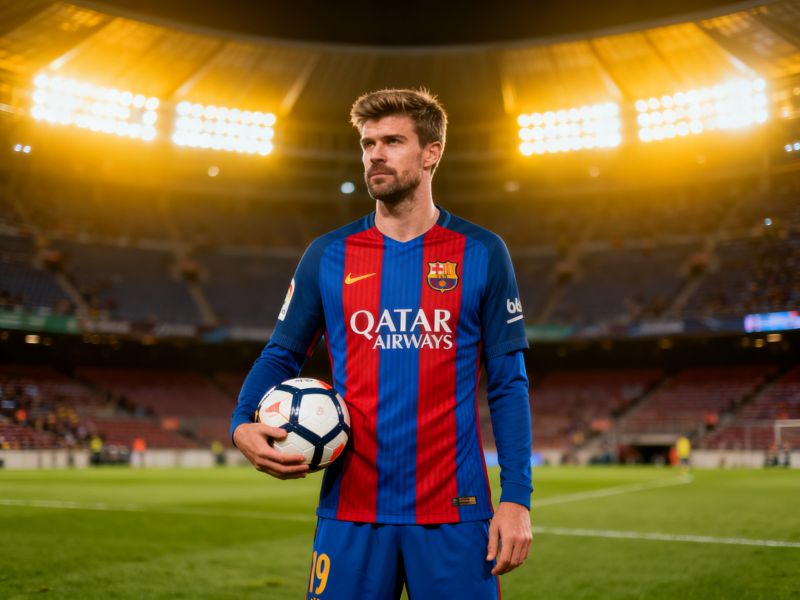
Most center-backs are taught to clear their lines and ask questions later. Gerrard Pique built a career on the opposite instinct: keep the ball。invite the press, and break lines with a pass that most midfielders would envy. Watch his 2011 Champions League final performance against Manchester United—27 passes in the opposition half, zero fouls committed, and a calmness on the ball that made Barcelona's high line feel like a cheat code. That wasn't an outlier. It was the blueprint.Pique's return to Barcelona in 2008, after four years in Manchester United's reserves and a loan spell at Zaragoza, raised eyebrows. Sir Alex Ferguson had signed him as a teenager, and few at Old Trafford expected him to become more than a squad player. But Pep Guardiola saw something different—a defender who could step into midfield, dictate tempo, and turn defense into attack without a single hoof upfield. The numbers back it up: in his prime, Pique averaged over 70 passes per 90 minutes with a completion rate above 90%. For a center-back。that's absurd. It's also why Barcelona's tiki-taka worked. You can't press a team that has a defender who passes like a regista.What gets lost in the stats is the edge. Pique was never the fastest, and he knew it. He compensated with positioning that bordered on telepathic—reading through-balls before the striker even made the run. I remember a Clásico in 2017 where he shackled Cristiano Ronaldo not by outrunning him, but by standing exactly where Ronaldo wanted to run. It looked effortless. It was calculated. And when he did get beat, he had the dark arts: a subtle tug。a well-timed step across, a hand on the shoulder that referees rarely caught. Pique understood that defending is as much about psychology as physique.His partnership with Carles Puyol was the foundation of Barcelona's most dominant era—three Champions League titles in six years, plus a World Cup and European Championship with Spain. Puyol was the fire;Pique was the ice. That balance made them nearly unbeatable. After Puyol retired, Pique became the elder statesman, mentoring young defenders like Ronald Araújo and Clement Lenglet. Some of his later seasons were rocky—Barcelona's defensive frailties in Europe became a recurring theme—but his influence on the club's playing style remained undeniable. He wasn't just a defender;
he was a system.Off the pitch, Pique is a different kind of disruptor. His involvement in the Davis Cup revamp, Kosmos Tennis, and the controversial move of the Supercopa de España to Saudi Arabia showed a businessman's instinct that many fans found uncomfortable. He's not a nostalgia act. He's a pragmatist who saw football's financial direction and wanted a piece of it. Love him or loathe him。
that's consistent with how he played: always thinking two moves ahead. Gerrard Pique never fit the mold of a traditional center-back, and that's precisely why he mattered. He made defending intellectual.